Why Is Japan Blocking the Mount Fuji View?
One town, one convenience store, one 20-metre screen, and a headline that travelled a lot further than the facts did. Here is what was actually blocked, why, and what the spot looks like now.
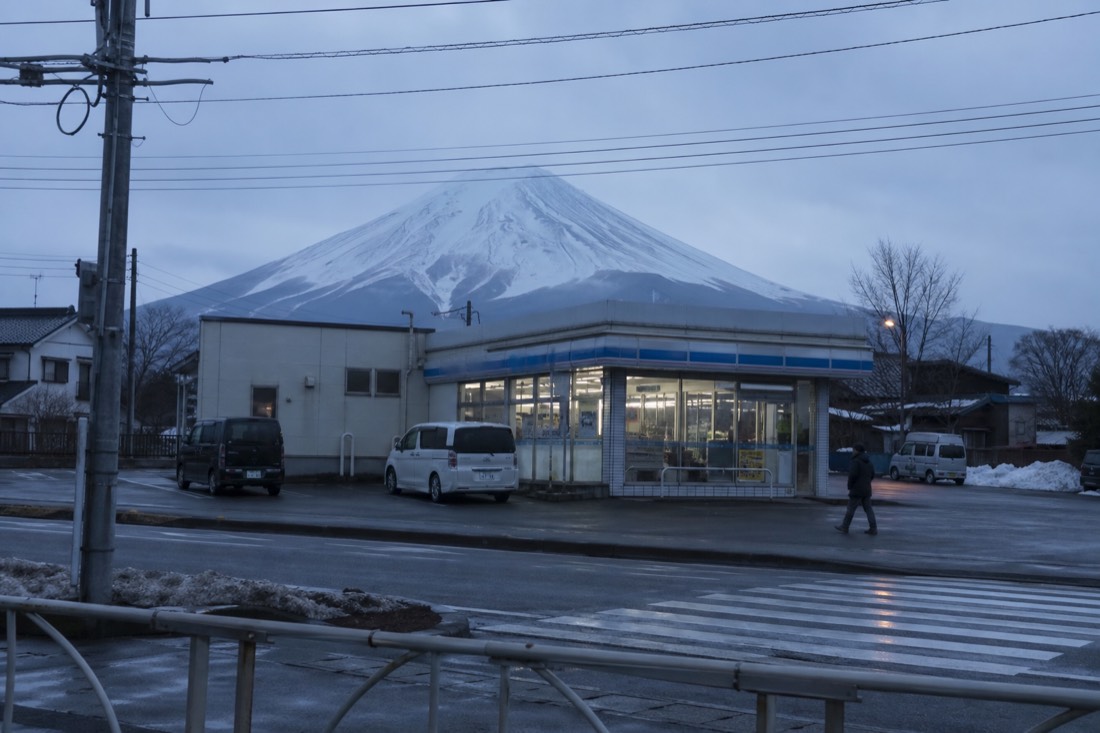
In May 2024 a small Japanese town put a black mesh screen across a pavement, and within days it was an international story about Japan hiding its most famous mountain from tourists. The reality was narrower, more local, and more about a pedestrian crossing than about scenery.
The useful booking decision is which wider Fuji route you want, rather than access to one shopfront photograph. Compare a fixed viewpoint circuit with a private day below.
Booking Summary: Use the public viewpoints and respect local crossing rules. A coach links several photo stops; a private car gives you a route to discuss with the operator. Neither guarantees a clear mountain or privileged roadside access.
Scroll to the end for the complete comparison and provider booking links. Interactive matching requires JavaScript.
Why is Japan blocking the Mount Fuji view?
It is not. One town, Fujikawaguchiko in Yamanashi, erected a black screen in front of a single convenience store in May 2024 because visitors photographing the mountain from that spot were standing in a live road, trespassing on a neighbouring clinic's car park and leaving rubbish. The screen came down that August and has not gone back up.
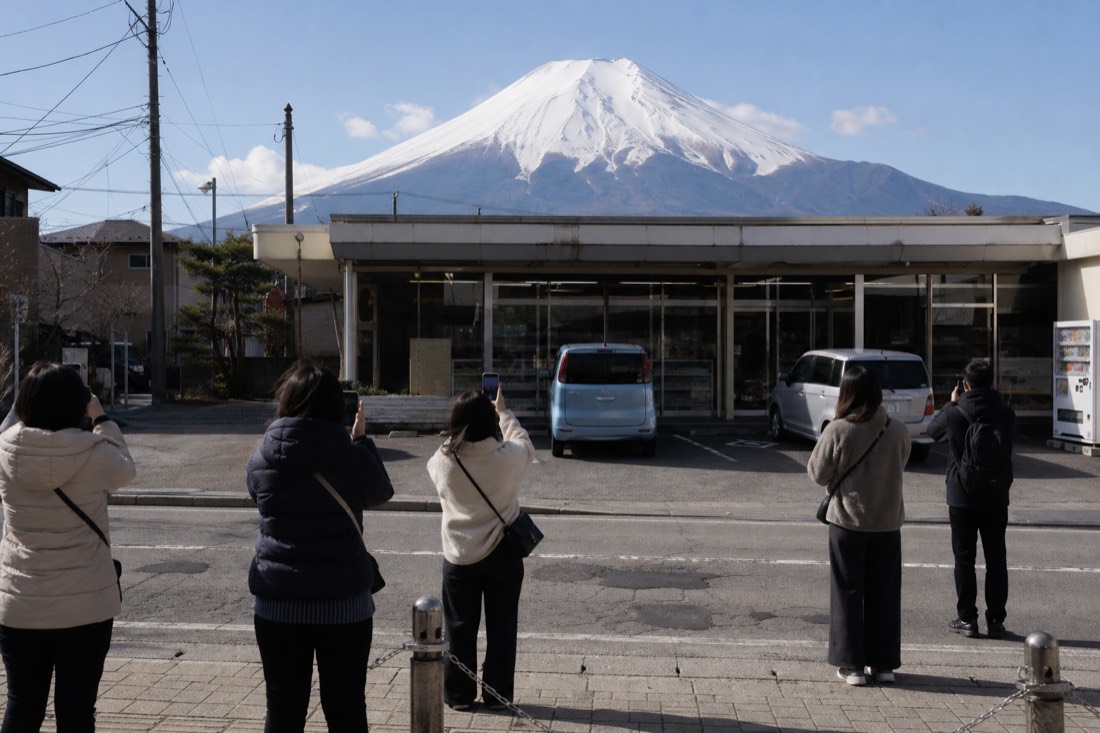
Nothing else was blocked. The mountain is visible from every public viewpoint it was visible from before, including the lake shores, Oishi Park, the Chureito Pagoda and the ropeway. What changed at that one junction was where you are allowed to stand.
Which Lawson can see Mount Fuji?
The Lawson Kawaguchiko Ekimae branch, near Kawaguchiko Station in Fujikawaguchiko. Photographed from the pavement opposite, the shop's flat roof lines up under the mountain so precisely that Mount Fuji appears to be sitting on top of a convenience store.
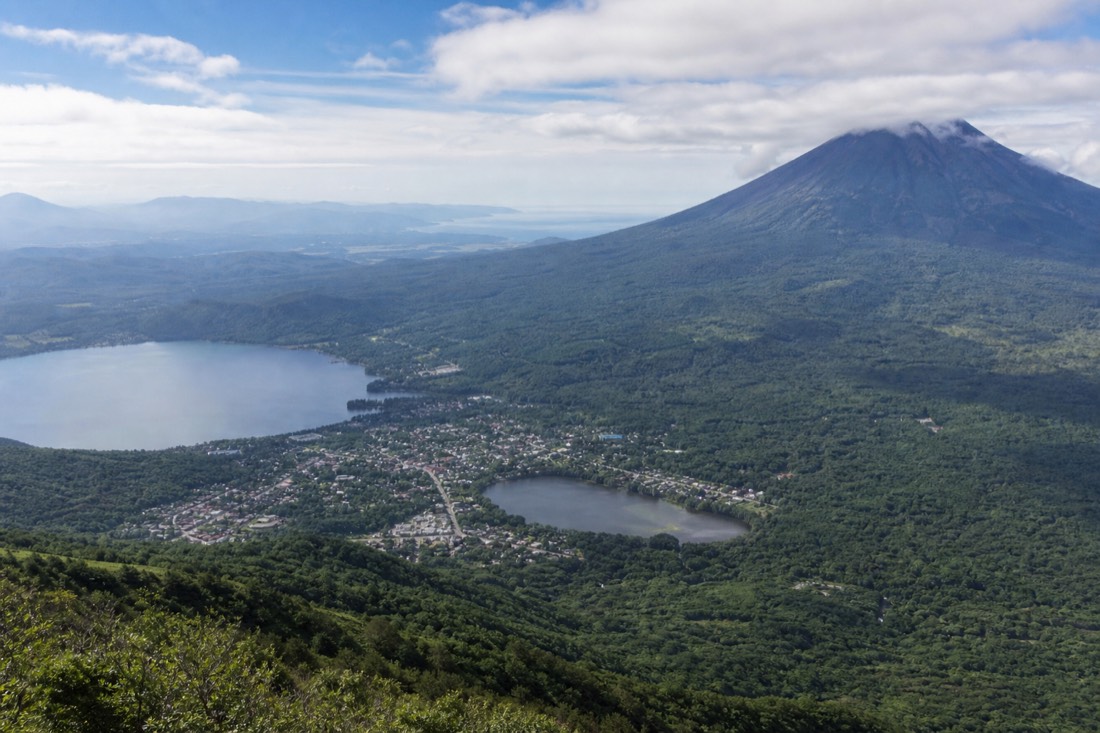
That composition is the entire reason for the story. It is an ordinary suburban shop in front of an extraordinary mountain, and the visual joke of the two together travelled around social media until the junction outside was carrying crowds it was never built for. The store itself did nothing to invite it.
What did the town actually do, and when?
A black mesh screen roughly 20 metres long and 2.5 metres high went up on 21 May 2024. It was taken down on 15 August 2024, ahead of an approaching typhoon, and the town said it would not reinstall it if visitor behaviour stayed better. It has stayed down since.
| Date | What happened |
|---|---|
| Early 2024 | Crowds build at the junction; the town adds signage, then stewards |
| 21 May 2024 | The black screen goes up, about 20 m long and 2.5 m high |
| 15 August 2024 | The screen is removed as a typhoon approaches, with no plan to reinstall |
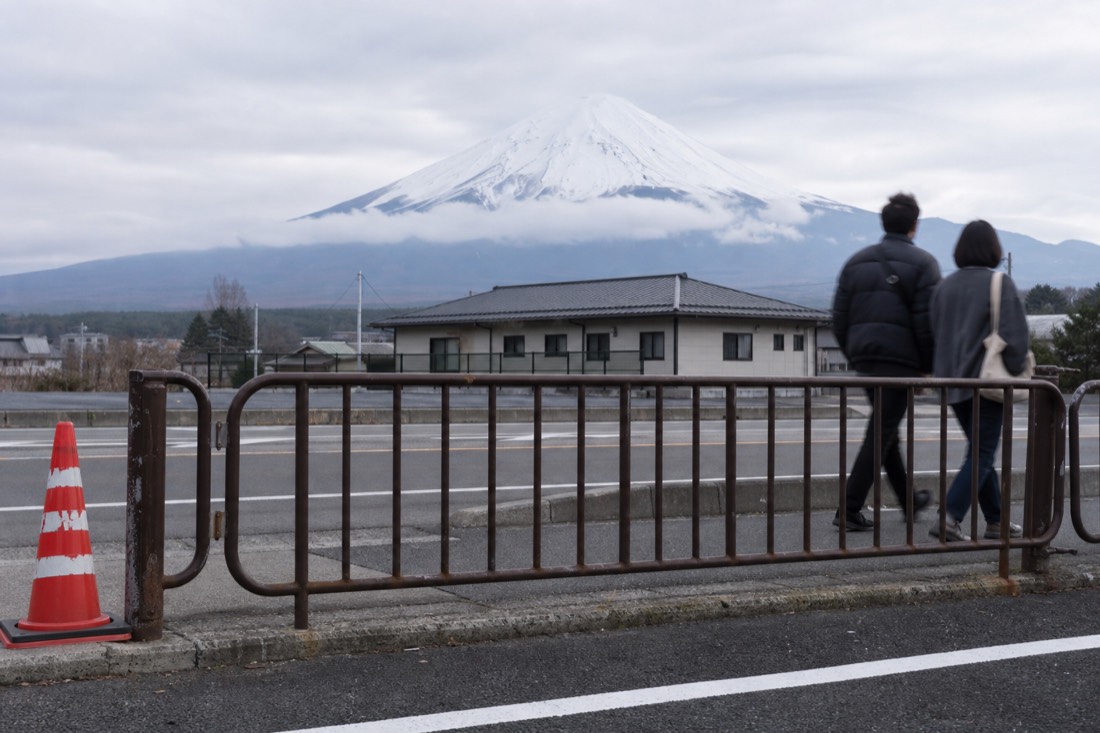
| 7 August 2025 | A lower brown guard-rail, around 1.4 m, is installed for road safety |
| 2026 | No view-blocking screen. The mountain is photographable from the pavement |
The reasons the town gave were consistently practical rather than aesthetic. Reporting by the Associated Press at the time listed jaywalking, standing in the road, litter, smoking and people walking onto the property of a dental clinic next door.
The Mainichi carried the same list from the town's own briefings, and the BBC covered it as an overtourism story rather than a scenery one. When CNN reported the removal that August, the framing had not changed: the barrier had been a response to behaviour, and behaviour had improved.
Chureito, Kawaguchiko & Oshino: Scheduled Dates
Link Chureito Pagoda, Oishi Park and Oshino Hakkai in one day by coach.
Check Dates For Chureito, Kawaguchiko & OshinoIs the view blocked now?
No. As of 2026 there is no tall screen at the site. The lower guard-rail installed in August 2025 is a pedestrian safety measure at kerb height and does not obstruct the mountain. What you are expected to do is stay on the pavement, cross at the crossing, and not step into the road for a better angle.
That is worth taking seriously, because the barrier is the model for what happens next. Fujikawaguchiko has added stewards, multilingual signage, painted standing areas and parking enforcement at several roadside spots, and it has been open about the fact that measures escalate when they need to. The screen was not a one-off act of spite. It was one step on a ladder, and the town chose to step back down it.
What else has changed around the mountain?
Quite a lot, and most of it is on the mountain rather than around it. The Yoshida Trail now has a physical gate, a ¥4,000 climbing fee, a cap of 4,000 climbers a day, and a rule closing the gate between 2:00 PM and 3:00 AM to anyone without a mountain hut reservation.
Those rules exist because of a specific problem: overnight climbers pushing straight from the fifth station to the summit without acclimatising or sleeping, in street clothes, and needing to be rescued. Registration is handled through the prefectures' climbing portal, and it is not something to leave until the morning of the climb. Our guide to the four official climbing routes covers the rules trail by trail.
There is one more change coming that will affect visitors who stay overnight rather than climb. From April 2027, Fujikawaguchiko and Fujiyoshida introduce a lodging tax of ¥200 per person per night. It is small, it is real, and it is being introduced explicitly to fund the management of tourist numbers.
Where should you photograph Mount Fuji instead?
Anywhere on the northern shoreline, and preferably before 9:00 AM. The convenience-store shot was always a novelty rather than the best view in the area, and the genuinely good vantage points sit within a short bus ride of the same station.
The timing matters more than the location. Mount Fuji builds its own cloud through the day, so the difference between a 7:30 AM arrival and an 11:00 AM one is larger than the difference between any two viewpoints on this list. Our page on when the mountain is actually visible carries the month-by-month figures, and a hoto lunch afterwards is covered in what to eat near Mount Fuji.
| Viewpoint | What you get | Best time |
|---|---|---|
| North shore of Lake Kawaguchiko | Full profile with a mirror reflection on a still morning | First light, before the wind picks up |
| Oishi Park | Open sightlines with seasonal flower foregrounds | Early morning, any season |
| Chureito Pagoda, Arakura | The pagoda, the town and the peak stacked in one frame | Early April for blossom, November for foliage |
| Oshino Hakkai | Spring-fed ponds and thatched roofs below the mountain | Before the coaches arrive, around 8:30 AM |
| Honcho Street, Fujiyoshida | The mountain closing the end of a working shopping street | Late afternoon, long shadows |
The town's own response to the crowding has been to point people at exactly this kind of dispersal: more spots, better signage, fewer people in one place. If you want the route planned around the light rather than around the car park, the photo-spots day tour from Tokyo runs the circuit in the order that works, and our page on the best viewpoints around the mountain covers the rest. Most of the guided Mt. Fuji tours we list build their morning around the same shoreline. Whichever you pick, the mountain is not hidden. It never was.