Fuji Scenic Spots Explained
Where are the best Mt. Fuji viewpoints? Compare Kawaguchiko, Chureito Pagoda, Oishi Park, and more to plan the perfect Fuji day.
Last updated: May 12, 2026
Choose the viewpoint you most want, then check that it appears in the actual tour. A product named “Mt. Fuji” does not automatically include every stop in this guide.
Booking Summary: The Tokyo coach names Chureito, Oishi Park and Oshino Hakkai. The local private day can discuss selected lakes-area stops, while a Tokyo private day adds hotel pickup.
Scroll to the end for the complete comparison and provider booking links. Interactive matching requires JavaScript.
Quick Reference: Mt. Fuji Scenic Spots at a Glance
| Kawaguchiko north shore / Ubuyagasaki | Lake reflection, wide full-profile view | Free | Oct to Feb for reflection; Apr for cherry blossoms |
| Chureito Pagoda (Arakurayama Sengen Park) | Pagoda-framed iconic photography | Free; 398 steps | Late Mar to mid-Apr (cherry blossoms); Oct to Nov |
| Oishi Park | Seasonal flower foreground, casual north shore walk | Free | Jun-Jul (lavender); Oct-Nov (kochia); Apr (cherry) |
| Oshino Hakkai | Traditional village, spring ponds, cultural depth | Free (¥300 for Hannoki museum) | Apr to Nov best; open year-round |
| 5th Station (Fuji Subaru Line) | Closest road access to the mountain; views from 2,305m | Free to visit (¥4,000 climbing fee to hike) | Year-round; road closes Dec to early April to private cars |
| Lake Yamanaka | Diamond Fuji, quieter views, larger lake | Free | Oct-Nov and Jan-Feb for Diamond Fuji; all year for views |
What Are the Best Scenic Spots Around Mount Fuji?
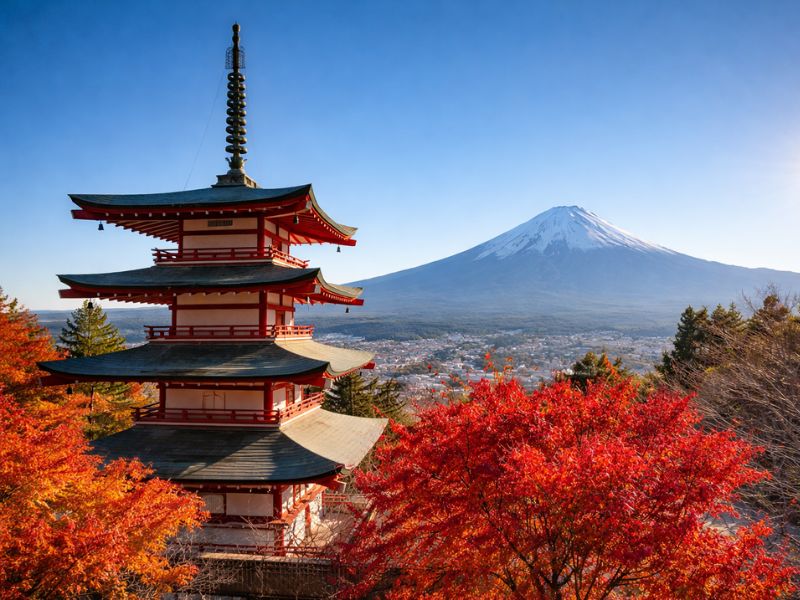
The six main scenic spots around Mt. Fuji each give you a different frame for the same mountain: the north shore lake reflection at Kawaguchiko, the pagoda-foreground at Chureito, the seasonal flower fields at Oishi Park, the traditional spring village at Oshino Hakkai, the closest road-accessible point at the 5th Station, and the extended Diamond Fuji viewing window at Lake Yamanaka. They serve different purposes and different seasons. None of them is redundant. Knowing what each does is the starting point for planning a visit that actually delivers what you came for.
The mistake most visitors make is treating all six as interchangeable sightseeing stops to be collected in a single day. They are not. Chureito Pagoda is a photography destination that earns itself in cherry blossom season and loses most of its reason to visit on cloudy summer days. Oshino Hakkai is a cultural stop with independent value regardless of whether the mountain is visible. The 5th Station is a proximity experience that puts you inside the mountain’s presence, not in front of it. Lake Yamanaka is quieter than Kawaguchiko by a wide margin and has a specific seasonal magic that most day-trippers never access.
The unifying truth across all of them: none guarantees a visible mountain. Mt. Fuji is visible roughly 80 to 100 days per year from the Kawaguchiko area, with winter being by far the most reliable season and summer the least. Every spot in this guide is worth visiting for reasons independent of the mountain’s cooperation. But the mountain being clear transforms every one of them. One roadside spot near Kawaguchiko Station briefly became famous for the wrong reasons, which is the story behind the Lawson photo spot.
This guide covers each spot in turn, explaining what it actually is, what makes it worth visiting, when to go, how to get there, how long to spend, and what most visitors get wrong about it. We have been guiding groups through these spots since 2012, including on the Highlight Photo Spots day tour from Tokyo, and every section below reflects that direct experience with 11,500 travelers.
Never done a Mount Fuji tour before and not sure what you’re actually signing up for? Here’s our what to expect on a Mount Fuji tour guide so there are no surprises on the day.
Lake Kawaguchiko: The Classic North Shore View
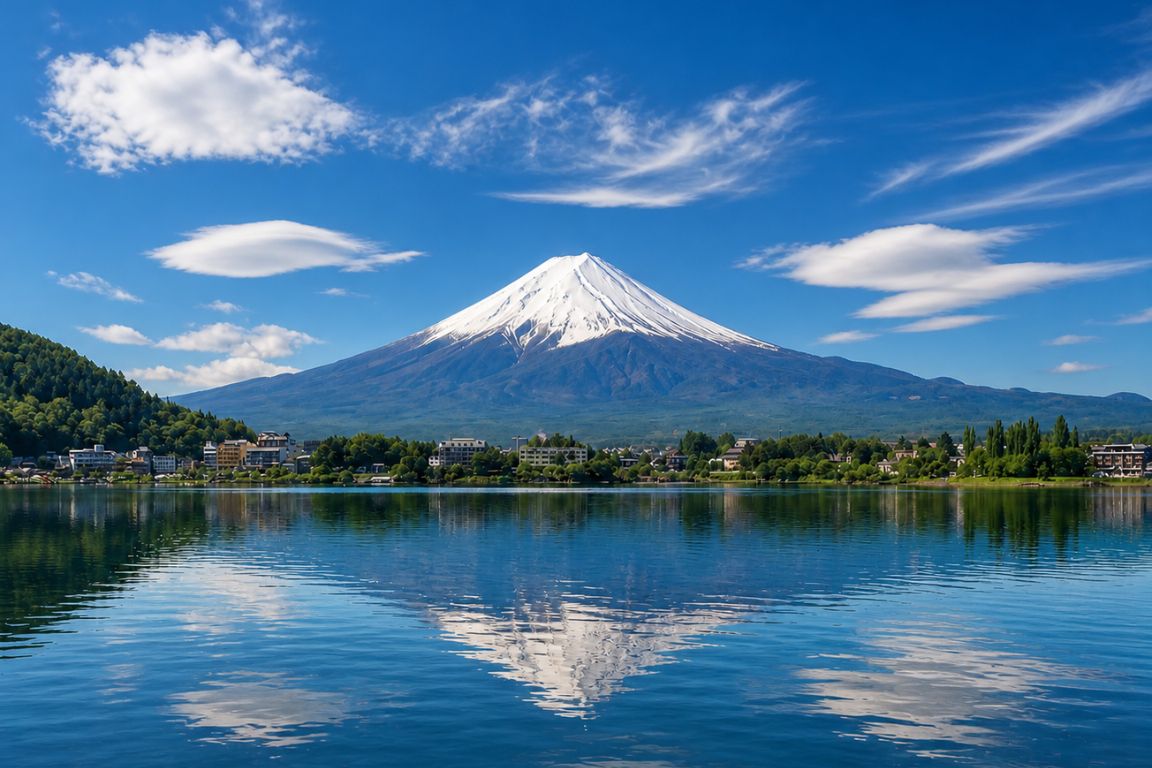 The north shore of Lake Kawaguchiko delivers the clearest, widest unobstructed view of Mt. Fuji of any easily accessible location in Japan. The mountain’s full profile, from base to summit, is visible across the lake’s surface. On still mornings with clear skies, the reflection creates the “Sakasa Fuji” (Upside-Down Fuji), one of the most photographed natural images in the country. The key viewpoint is Ubuyagasaki, a small promontory on the north shore about 1 km west of the Kawaguchiko Ohashi Bridge. The best window: 6:00 to 9:00 AM, from autumn through winter.
What makes this spot different from every other viewpoint around the mountain is the completeness of the view. From Chureito Pagoda you see the mountain over the pagoda. From the 5th Station you see the mountain from within it. From the Hakone shore you see the mountain at a distance through haze. From the north shore of Kawaguchiko, you see the entire mountain, symmetrical, from base to peak, with nothing in the foreground except water. The ridgeline extends fully to both sides of the summit cone. When the light is right and the lake is still, this is the image that has appeared on banknotes, in Hokusai’s prints, and in every significant Japanese artwork featuring the mountain for three centuries.
Ubuyagasaki is a small rocky cape about a 30 to 40-minute walk from Kawaguchiko Station (or 10 minutes by Red Line sightseeing bus to the stop near the Ohashi Bridge, then a short walk along the north shore). There is a tiny historic shrine here, Ubuyagasaki Shrine, built in 865 AD. The cape protrudes into the lake slightly, giving a wider angle of view than the straight north shore path. The reflection shot is taken from the shore just east or west of the cape, depending on conditions and composition. Photographers routinely arrive before sunrise and wait out any morning wind, which can break the mirror surface. In February, the clear, cold air and windless mornings produce the best reflection conditions of the year.
The walk from Kawaguchiko Station west along the north shore, crossing the Ohashi Bridge and continuing west, is genuinely pleasant even without the mountain. The lakeside path is mostly flat, passes several small cafes and viewpoints, and ends at Oishi Park about 4 km west of the bridge. By bicycle it takes 20 minutes; on foot, 50 to 60 minutes. The early morning hours before 9:00 AM are when this walk is at its best: the path is nearly empty, the lake may still be calm, and the mountain is at maximum probability of being clear.
What most visitors get wrong here: arriving after 10:00 AM. The thermal activity that clouds the mountain builds from the late morning on most days. The reflection requires both clear sky and no wind, which is a morning condition. Afternoon visits to the north shore on summer or autumn days frequently disappoint because the mountain has vanished.
Key details: Free access. Open 24 hours. Red Line sightseeing bus from Kawaguchiko Station stops near the Ohashi Bridge (Kawaguchiko Natural Living Center for Oishi Park). Bicycle rental near Kawaguchiko Station for ¥1,000 to ¥2,000 half day. Elevation approximately 830 meters – bring a layer.
Want to fit the best Fuji lake views into your Tokyo itinerary without losing the whole day to travel? Here’s our Kawaguchi day trip from Tokyo guide so you use your time wisely.
Chureito Pagoda: The Most Photographed View in Japan
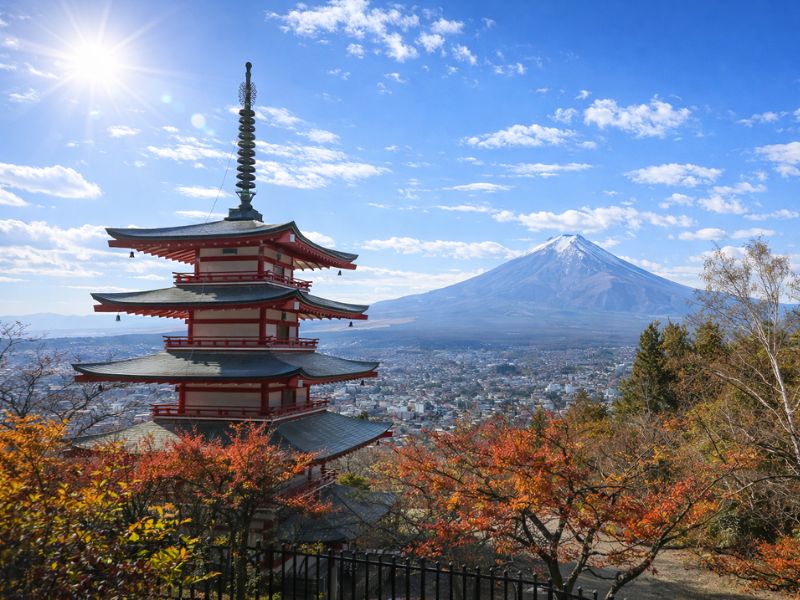
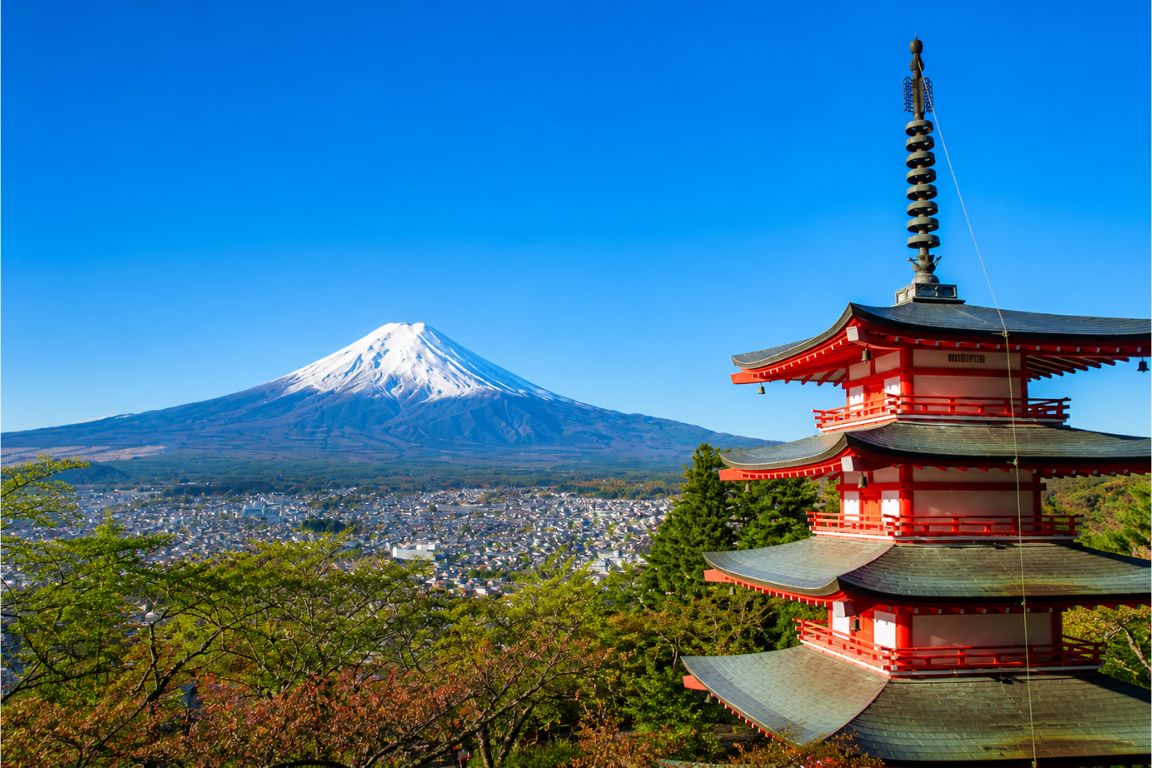 Chureito Pagoda at Arakurayama Sengen Park is the viewpoint that produces the single most recognized travel photograph of Japan: a five-story red pagoda in the foreground, Mt. Fuji filling the sky behind it, cherry blossoms layered between. It is located in Fujiyoshida City, a 15-minute Fujikyu Railway ride from Kawaguchiko Station to Shimoyoshida Station, then a 15-minute walk and a 398-step climb to the observation platform. Entry is free. The pagoda earns its reputation most fully in cherry blossom season (late March to mid-April) but is worth visiting in autumn foliage and on any clear winter morning.
The pagoda was built in 1963 as a peace memorial – not an ancient temple, as many visitors assume – but its position on the hillside above Fujiyoshida is as close to compositionally perfect as any viewpoint around the mountain. The observation deck sits at a height that puts the pagoda in the mid-foreground, the city of Fujiyoshida in the lower distance, and Mt. Fuji’s upper cone visible above the city’s roofline. On clear spring mornings with cherry blossom trees in bloom along the stairway and around the platform, this is a photograph that requires no editing to justify its reputation.
The 398 steps are the most honest challenge here. The stairway starts from the entrance gate to Arakurayama Sengen Park at road level and climbs the forested hillside to the main shrine complex and then the observation deck above it. Allow 15 minutes for the ascent if reasonably fit. The steps are uneven in places and the final section is steep. People with significant mobility limitations will find it difficult. There is no elevator or alternative route.
The crowd situation at Chureito is significant and has worsened over the years. Fujiyoshida City cancelled the official Cherry Blossom Festival at the park for 2026 due to overtourism concerns. Whether it returns in 2027 is unclear. On peak cherry blossom weekends, the queue to photograph in front of the pagoda can be 30 to 60 minutes. Weekday mornings before 8:00 AM are dramatically quieter. Arriving before the light gets harsh is also better for the photograph – the mountain faces mostly south and the early morning light from the east illuminates the front face of the cone well.
Insider tip: most visitors stop at the main observation platform and turn around. About 5 to 10 minutes further up the forested hill above the pagoda, there is a secondary viewpoint where the pagoda drops out of frame but the mountain fills more of the sky with significantly fewer people. It is not signposted but the path continues clearly upward from the main platform. This upper viewpoint is worth the additional effort.
What most visitors get wrong here: visiting in cloudy weather. When the mountain is hidden, this is a nice shrine park with 398 steps and a view of a pagoda with a grey backdrop. The visit earns itself only when the mountain is clear. Check the forecast before you go.
Key details: Free entry to park and observation deck. Fujikyu Railway from Kawaguchiko Station to Shimoyoshida Station (~15 min, ~¥240); 15-minute walk + 398 steps. No elevator. Open always. Best light: early morning. Best season: late March to mid-April and mid-October to mid-November.
Oishi Park: Seasonal Flowers and the Open Lake Panorama
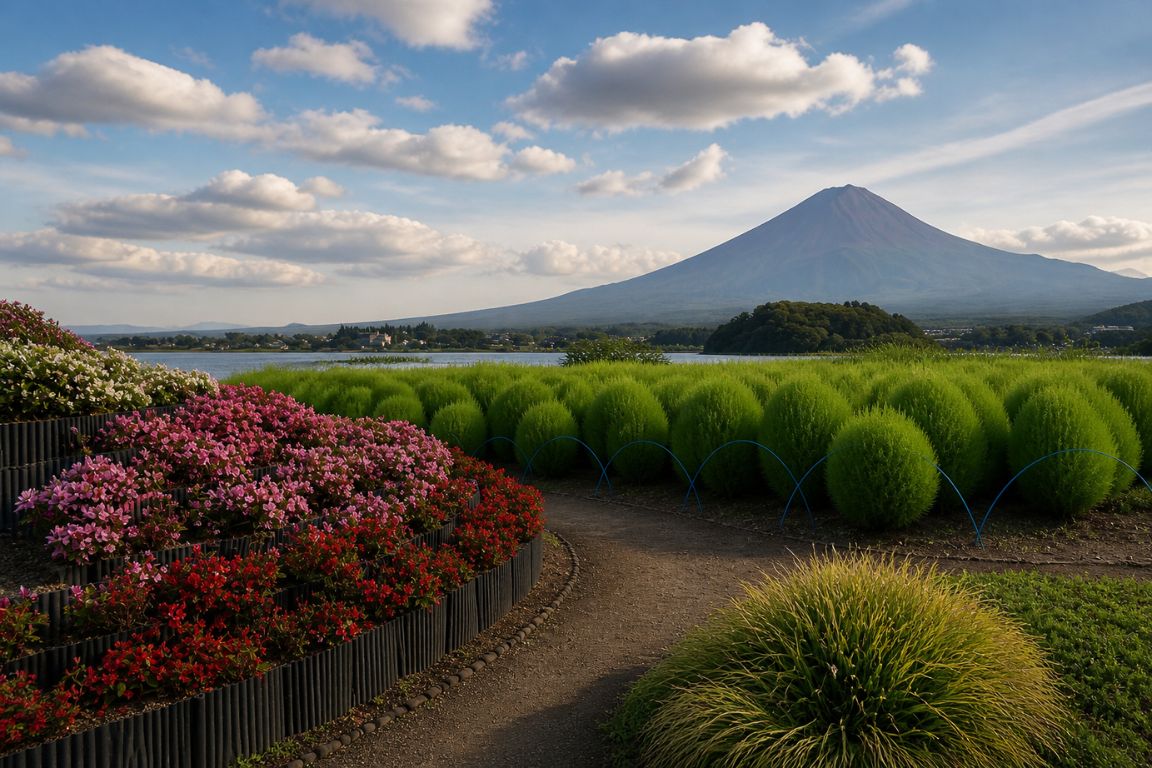 Oishi Park sits at the western end of Lake Kawaguchiko’s north shore and is the best spot around the lake for combining a seasonal flower foreground with a wide view of Mt. Fuji. Lavender blooms from late June to mid-July. Crimson kochia (round grass bushes) fill the park in October and November. Cherry blossoms frame the shoreline in mid-April. The park is free, accessible by the Red Line sightseeing bus (last stop on the Red Line, approximately 20 minutes from Kawaguchiko Station), and open all day. For Mt. Fuji photography with a seasonal foreground, this is the most reliably accessible location in the area.
What distinguishes Oishi Park from the Ubuyagasaki reflection spot is the deliberate seasonal landscaping. The park is actively managed to provide photogenic foregrounds: the lavender beds are planted and maintained, the kochia is cultivated, the cherry tree line along the shore path is tended. The result is that in each season’s peak window, there is a specific and photogenic foreground awaiting you – purple, crimson, or pink – with the mountain behind it. This is not accidental scenery. It is curated, and it shows in the photographs.
The park also has the most open and horizontal view of Mt. Fuji of any roadside stop in the area. Standing at the Oishi Park shore looking east-southeast, the mountain rises above a largely unobstructed horizon with the lake below it. The perspective is wide – the ridgelines on both flanks are visible all the way to the base – which is harder to achieve at more central north shore spots where minor obstructions exist.
Oishi Park’s free access and bus connectivity make it the most practical first stop on a north shore visit. The Red Line bus departs Kawaguchiko Station every 15 minutes from 9:00 AM, takes about 20 minutes, and drops you directly at the park (Kawaguchiko Natural Living Center stop). The return bus stops at the same location. For photographers doing the full north shore walk, Oishi Park is the western endpoint and the walk east from here to Ubuyagasaki covers the best concentrated section of north shore viewpoints in about 40 to 50 minutes on foot.
The Oishi Park living center also sells soft-serve ice cream using local fruit and blueberry produce, and the lakeside terrace has simple food and drink. These are not the reason to come but they make the stop more comfortable in cold winter mornings or hot summer afternoons.
What most visitors get wrong here: arriving by bus at 11:00 AM hoping for the lavender photograph in July. By that hour the mountain has typically acquired its cloud skirt and the foreground, however beautiful, is framed by grey. Go early.
Key details: Free. Red Line sightseeing bus from Kawaguchiko Station (~20 min; day pass ¥1,500). Open year-round. Best seasons for foreground photography: late June to mid-July (lavender), October to November (kochia), mid-April (cherry). All prices verified May 2026.
The train and bus to Mount Fuji differ more than just the route – our train vs bus to Mount Fuji guide breaks down the real differences in cost, journey time, flexibility, and where each one actually drops you off.
Oshino Hakkai: The Spring Village at Fuji’s Base
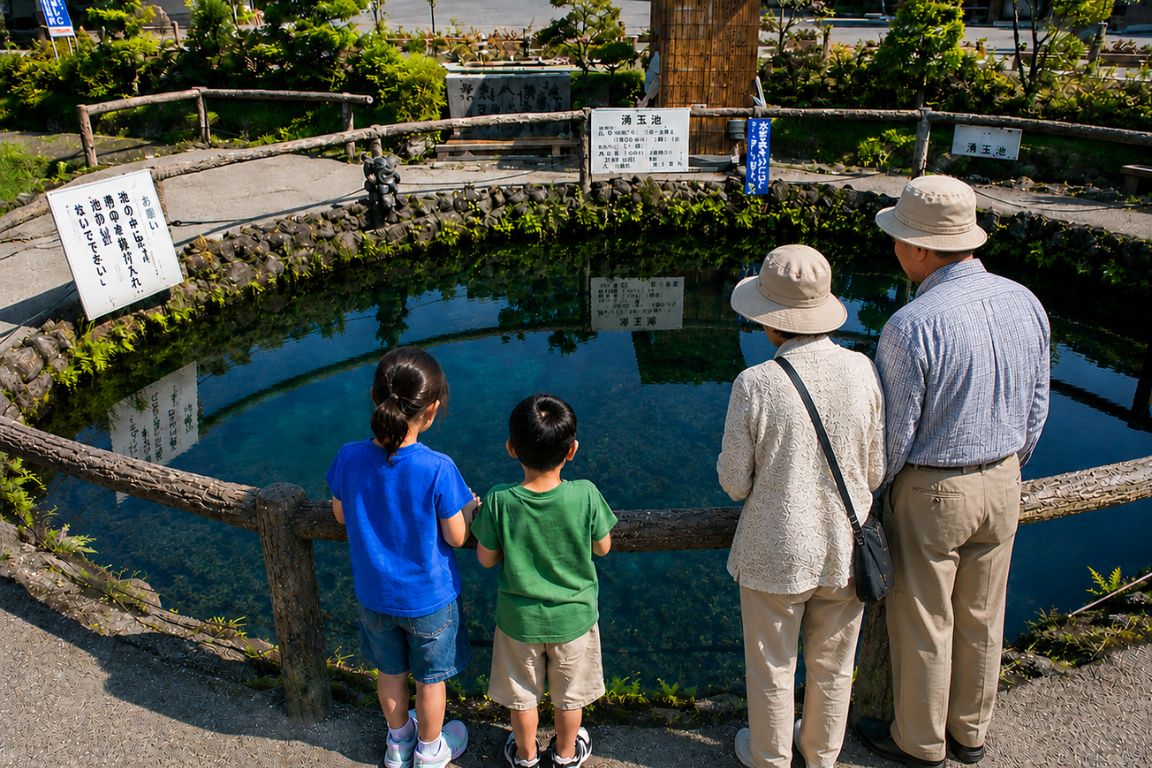 Oshino Hakkai is a small traditional village between Lake Kawaguchiko and Lake Yamanaka, built around eight spring-fed ponds supplied by Mt. Fuji’s snowmelt filtered through volcanic rock for approximately 80 years. The ponds are extraordinarily clear, blue-tinted, and in a good light appear to have no bottom. The village has thatched-roof farmhouses, water wheels, local food stalls, and views of Mt. Fuji on clear days. Entry to the ponds is free; the Hannoki Bayashi open-air museum surrounding the largest pond charges ¥300. Allow 45 to 60 minutes for a thorough walk. This spot holds up well on cloudy days, making it the most weather-independent stop in the Five Lakes area.
Oshino Hakkai carries more cultural history than most visitors realize. The eight ponds were used during the Edo period by Mt. Fuji pilgrims for ritual purification before ascending the mountain. Each pond is dedicated to one of Buddhism’s eight dragon kings. The village layout, with its Big Dipper constellation pattern of ponds, was a deliberate spiritual geography. The water from Waku-ike, the central and most famous of the eight ponds, produces approximately 8.4 million liters of spring water daily and is ranked among the nation’s best spring water by Japan’s Ministry of the Environment. In 1983, water from this pond was used by NASA for space snow-making experiments.
The landscape at Oshino, when Mt. Fuji is visible, produces something rare: a traditional Japanese village tableau with thatched roofs and water wheels in the foreground, blue crystal ponds in the middle ground, and the mountain filling the horizon behind. On a still autumn morning this combination is genuinely extraordinary. Even when the mountain is hidden, the ponds are beautiful in their own right – the water is clear enough to watch koi fish swimming in apparent suspension 2 to 3 meters below the surface.
One useful clarification: the most-photographed image associated with Oshino Hakkai, showing a small circular pond with thatched buildings behind it and Mt. Fuji above, is actually Naka-ike, an artificial pond adjacent to the souvenir shops. It is not one of the official eight ponds and is not part of the World Heritage designation. It is, however, beautiful and widely photographed. The official eight ponds require more exploration and some are quieter and less developed than the main tourist area around Naka-ike and Waku-ike.
Oshino Hakkai sits about 30 minutes from Kawaguchiko Station by bus (Fujikko Bus toward Oshino Hakkai, the F-line). By car it is about 10 minutes from the Yamanakako IC exit. In the context of a day trip from Tokyo, it works well as an afternoon stop after the lakeside viewpoints in the morning, since it does not require the same morning urgency as the reflection shot or Chureito.
What most visitors get wrong here: confusing the artificial Naka-ike pond (the most photographed, surrounded by souvenir shops) with the actual eight heritage ponds. For the real experience, walk beyond the central commercial area. Deguchi-ike, the most remote of the eight, is the least crowded and has a genuinely serene atmosphere.
Key details: Free to walk. Hannoki Bayashi museum: ¥300 (9:00 AM to 5:00 PM daily). Bus from Kawaguchiko Station: ~30 min on F-line Fujikko Bus. Sokonashi-ike (one of the eight) is inside the paid museum and not accessible independently. All prices verified May 2026.
Chureito, Kawaguchiko & Oshino: Scheduled Dates
Link Chureito Pagoda, Oishi Park and Oshino Hakkai in one day by coach.
Check Dates For Chureito, Kawaguchiko & OshinoThe 5th Station: Getting Close Without Climbing
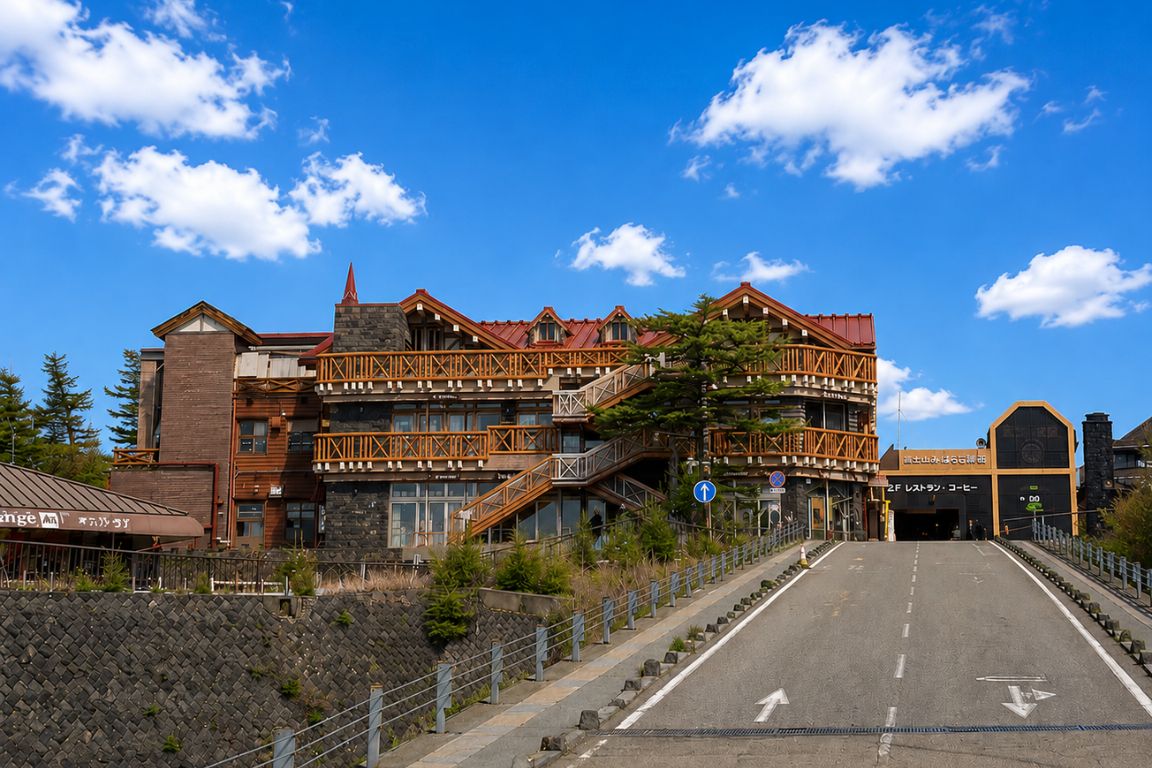 The Fuji Subaru Line 5th Station is the highest point on Mt. Fuji accessible by road, at 2,305 meters above sea level. It is not a viewpoint looking at the mountain, it is on the mountain. From here you look outward over the Fuji Five Lakes, Yamanashi Prefecture, and on very clear days Tokyo in the far distance. The upper slopes of the volcano rise above you. Shops, restaurants, a Shinto shrine, and a post office operate at the station year-round. Access by shuttle bus from Kawaguchiko Station takes about 50 minutes. Private cars are restricted during the July to September climbing season.
The 5th Station is one of the most common misunderstandings in Mt. Fuji tourism. Visitors who want to “see Mt. Fuji” up close and book a tour including the 5th Station sometimes arrive expecting a dramatic view of the mountain’s cone from a close vantage point. That is not what the 5th Station provides. You are on the mountain. You cannot see the mountain’s shape from that position, for the same reason you cannot see the shape of a building from inside it. What you see from the 5th Station is the view from halfway up: the volcanic terrain immediately above you, the tree line below, and the panorama of the surrounding landscape extending to the lakes and plains.
That view is genuinely impressive. On a clear day, the lakes below look like blue mirrors in the forest, the plains extend to the horizon, and the sense of scale of the landscape beneath the mountain is remarkable. The volcanic atmosphere – the grey-black cindery terrain, the thinning air at 2,305 meters, the smell of altitude – is something you cannot replicate at the lake viewpoints below. You feel the mountain differently from up here.
The 5th Station complex has several souvenir shops, a Fuji Volcano Arts and Science Museum on the third floor of the Rest House (free to enter), the Komitake Shrine, an outdoor observation area, and coin lockers for day packs. A post office operates here and you can mail postcards with the 5th Station postmark, a popular keepsake. The Ochudo Trail, a level walk that circles the mountain at roughly constant elevation, starts from the 5th Station and takes about 70 minutes for a partial circuit, this is a pleasant option for those who want to walk on the mountain without ascending toward the summit.
During the July to September climbing season, private vehicles are banned from the Subaru Line toll road due to congestion. All visitors must arrive by shuttle bus from the Fuji Hokuroku Parking Area near Fujiyoshida. Shuttle buses also run from Kawaguchiko Station. Outside the climbing season, private cars can drive the toll road directly to the 5th Station. The road closes in December and may not reopen until April depending on snow conditions.
What most visitors get wrong here: expecting to see Mt. Fuji from the 5th Station. You are on the mountain, not in front of it. If your goal is the postcard image of the cone, stay at lake level. The 5th Station is for experiencing the mountain, not photographing it.
Key details: Free to visit (no charge for vehicle or sightseeing, though the ¥4,000 climbing fee applies if you proceed past the trailhead gate during climbing season). Shuttle bus from Kawaguchiko Station: ~50 min, ¥1,950 one-way / ¥3,000 return. Private cars banned July 1 to September 10. Subaru Line toll road: ~¥2,100 round trip for private cars (outside climbing season). Temperature ~15°C cooler than Tokyo base. Prices verified May 2026.
Thinking about actually climbing Mount Fuji rather than just viewing it from below? Here’s our can you climb Mount Fuji on a tour guide so you know what’s genuinely involved before you commit.
Lake Yamanaka and Diamond Fuji
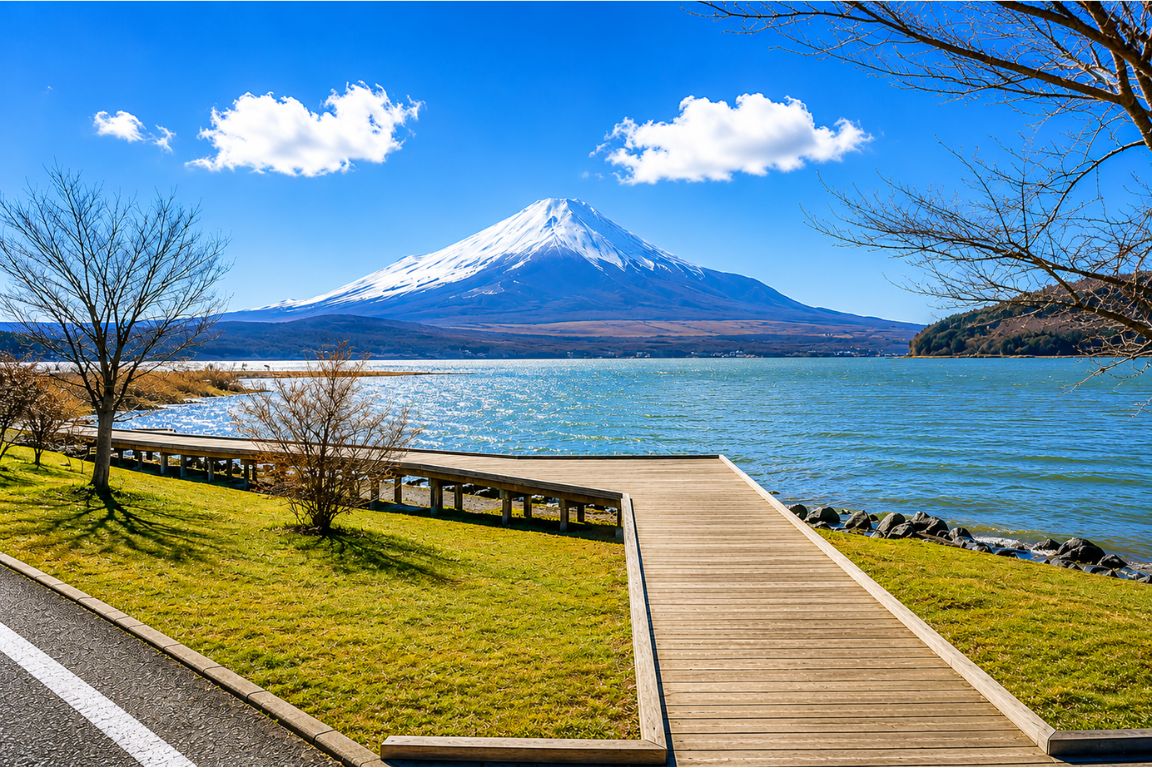 Lake Yamanaka is the largest and highest of the Fuji Five Lakes, sits closer to the eastern flank of the mountain than Kawaguchiko, and is significantly less developed for tourism. It is also the primary location in Japan for viewing Diamond Fuji – the phenomenon where the setting sun aligns exactly with Mt. Fuji’s summit, creating a blazing solar flare at the peak. From the north shore of Lake Yamanaka, Diamond Fuji is visible at sunset between approximately October 25 and February 20, with February designated as the official Diamond Fuji Weeks festival period. On the calmest days, the reflection doubles the event into “Double Diamond Fuji.” This is an annual spectacle that draws photographers from across Japan and the world.
Lake Yamanaka is the answer for travelers who found Kawaguchiko too crowded or too developed. The lake is larger, the shoreline less urbanized, and the atmosphere quieter. The mountain is visible from the north shore in a slightly different angle from Kawaguchiko – the eastern perspective reveals the mountain’s less-photographed flank, with the summit appearing to rise with a distinctive tilt that feels different from the perfectly centered north-shore view at Kawaguchiko. Hana no Miyako Park on the north shore has seasonal flowers (sunflowers in summer, cosmos in autumn) that provide foregrounds similar to Oishi Park but with fewer visitors.
Diamond Fuji is the specific and irreplaceable reason to visit Lake Yamanaka in the right season. The phenomenon occurs when the sun, setting due west of a viewpoint on the north shore, aligns precisely with the mountain’s summit on its descent. For a moment – sometimes only seconds – the sun sits directly on the peak and the mountain appears to hold a blazing diamond of light. If the lake surface is still, this event is reflected, creating the Double Diamond Fuji. Hirano Lakeside on the north shore and Panorama Dai (accessible by a short hike from the lake road) are the most recommended Diamond Fuji viewing spots.
The viewing window shifts slightly day by day as the sun’s position changes with the season. At Hirano Lakeside on the north shore, Diamond Fuji is visible from approximately October 27 to February 16 at sunset. The timing moves to roughly 4:00 to 4:50 PM depending on the date. February 1 to 22 is officially designated Diamond Fuji Weeks, when the weather is most stable, the snow cap is at its fullest, and events including an Ice Candle Festival with 3,000 candles and fireworks take place on February 22. Accommodation around the lake books out weeks in advance for this period.
Lake Yamanaka is accessible by highway bus from Shinjuku or Tokyo Station to Yamanakako (~2 hours, ~¥2,000 to ¥2,300 one way). It is also served by the Fujikko Bus from Kawaguchiko Station. By car, it is about 15 minutes from Kawaguchiko along Route 138.
What most visitors get wrong here: not knowing Diamond Fuji exists. Most first-time visitors to the area go to Kawaguchiko and never reach Yamanaka. If you are traveling in October, November, January, or February, the lake is an hour away from Kawaguchiko and the Diamond Fuji phenomenon is one of the most spectacular natural events accessible by public transport in Japan. Check exact daily alignment times from the official Lake Yamanaka tourism site (lake-yamanakako.com) before visiting.
Key details: Free access to all viewpoints. Diamond Fuji visible at sunset approximately October 25 to February 20, with February the most reliable period. Bus from Shinjuku: ~2 hours, ~¥2,000. Ice Candle Festival: February 22, 2026, free admission. Prices verified May 2026.
We’ve put together a full seasonal breakdown in our best time to visit Mount Fuji tours guide so you know exactly when to go based on what you want to see and how much company you’re willing to have.
Which Scenic Spot Should You Visit First?
Start at the north shore of Lake Kawaguchiko, specifically Ubuyagasaki and the path west toward Oishi Park, arriving before 9:00 AM. This gives you the widest clear view of the mountain in the best morning light. From there, the decision depends on season: if cherry blossoms or autumn foliage are active, go to Chureito Pagoda next. If it is afternoon and the mountain has disappeared, go to Oshino Hakkai, which holds up regardless of visibility. Add the 5th Station to any day trip if you want to experience being on the mountain, not just looking at it. Reserve Lake Yamanaka specifically for October to February when Diamond Fuji is possible.
The morning priority is not arbitrary. Mt. Fuji is most reliably visible before 9:00 AM and clouds build from the late morning onward. You have one clear-weather window in a day trip and it is between arrival and 10:00 AM. Front-loading your viewpoint stops before lunch, then shifting to weather-independent cultural stops in the afternoon, is the most consistent structure for a satisfying day regardless of season.
For a full-day visit covering the most essential spots:
7:00 to 7:30 AM: Arrive Kawaguchiko. Head immediately to north shore / Ubuyagasaki.
7:30 to 9:30 AM: North shore walk to Oishi Park. Best visibility window. Do not skip this for breakfast.
9:30 to 11:30 AM: Chureito Pagoda (if clear mountain). Fujikyu Railway to Shimoyoshida; 15-min walk; 398 steps.
12:00 to 1:00 PM: Lunch in Kawaguchiko town. Hoto noodles at Hoto Fudou or alternatives.
1:30 to 3:00 PM: Oshino Hakkai. Bus ~30 min. Walk the ponds. Soba or local food.
3:30 to 5:00 PM: 5th Station shuttle (if season allows; road open Oct to late Nov and late April to June). Or return to Kawaguchiko north shore for afternoon light.
One honest caveat about combining stops: five locations in one day is ambitious and often feels rushed. Two to three spots done properly – with time to sit at the north shore, properly explore Chureito, and walk through Oshino at a relaxed pace – will produce a better experience than five stops with 30 minutes each. If you have the flexibility for an overnight stay, the morning of Day 2 gives you a second visibility window, which is the most valuable thing an overnight adds.
For travelers focused on photography: the north shore in winter at pre-dawn to just-after-sunrise, Oishi Park in autumn for kochia, and Chureito in cherry blossom season are the three non-overlapping peak conditions. Planning a visit around one of them, rather than trying to hit all three in one trip, produces better results.
If you want the stops sequenced for your dates, the full-day private customizable tour from Tokyo is the direct way to choose which viewpoints to keep and which to drop.
First time attempting the Tokyo to Mount Fuji journey and not sure where to begin? Here’s our how to visit Mount Fuji tours from Tokyo guide so you don’t underestimate what the trip involves.
Which Spots Our Clients Visit Most: Data from Mt. Fuji Tours
| Kawaguchiko north shore / Ubuyagasaki | 95% | 92% |
| Oishi Park | 88% | 85% |
| Chureito Pagoda | 92% | 82% |
| Oshino Hakkai | 74% | 68% |
| 5th Station | 65% | 55% |
| Lake Yamanaka / Diamond Fuji | 35% | 91% |
The consistent pattern across 11,500 travelers: clients who arrive at the north shore before 9:00 AM on a clear day rate their experience highest, regardless of which other stops they visit. The north shore in the morning window is the single highest-return allocation of time in the entire area.
Frequently Asked Questions
Which Mt. Fuji scenic spot is best for photography?
For the iconic Japan travel photograph: Chureito Pagoda in cherry blossom season (late March to mid-April), arriving before 8:00 AM. For the widest, cleanest view of the mountain: the Kawaguchiko north shore at Ubuyagasaki, early morning from October to February. For seasonal flower foregrounds: Oishi Park in lavender season (late June to July) or kochia season (October to November). For the rare natural phenomenon: Lake Yamanaka for Diamond Fuji in October to November and January to February.
Do you need to pay to visit Mt. Fuji’s scenic spots?
Most are free. The Kawaguchiko north shore, Oishi Park, Chureito Pagoda, and Lake Yamanaka are all free to access. Oshino Hakkai ponds are free; the Hannoki Bayashi museum is ¥300. The 5th Station is free to visit as a sightseeing destination (the ¥4,000 climbing fee only applies if you proceed past the trailhead gate to climb). Transport costs (bus, train) and food are the main day trip expenses. Prices verified May 2026.
Which spot holds up on a cloudy day when Mt. Fuji is not visible?
Oshino Hakkai is the most weather-independent stop. The spring ponds, thatched village, and local food culture are engaging regardless of mountain visibility. Chureito Pagoda and the Kawaguchiko lakeside lose much of their purpose without a visible mountain. The 5th Station is interesting in any weather because you experience the mountain’s atmosphere from within it, though the outward views are better on clear days.
Can you visit all six spots in one day?
Technically possible on a long summer day but not recommended – each stop deserves more time than a rushed tick-list visit allows. Two to three stops done properly is more satisfying than five stops with 20 minutes each. The optimal combination for a first visit: north shore plus Oishi Park in the morning (same area), Chureito in mid-morning if clear, Oshino Hakkai in the afternoon. The 5th Station requires an additional 50-minute bus ride each way and fits better on a second day or overnight stay.
What is Diamond Fuji and when can you see it?
Diamond Fuji is the phenomenon where the setting (or rising) sun aligns precisely with Mt. Fuji’s summit, creating a solar flare effect at the peak. It is visible at sunset from Lake Yamanaka’s north shore from approximately October 25 to February 20 each year. February 1 to 22 is designated Diamond Fuji Weeks, with the clearest and most stable viewing conditions of the season. On windless days, the event reflects in the lake surface as Double Diamond Fuji. No fee; free to view from the lakeside.
If you want Chureito Pagoda, Lake Kawaguchi, and Oishi Park on one itinerary from Tokyo, see the Highlight Photo Spots day tour.
Written by Akira Nakamura
Japanese tour guide since 2012 · Founder, Mt. Fuji Tours
Akira has guided over 11,500 travelers up Mt. Fuji and through the Fuji Five Lakes region since founding the agency.